The Lowdown on Hiking the Inca Trail to Machu Picchu

Seeing Machu Picchu for the first time from the Sun Gate
When initially planning our RTW trip, we had a few must-sees and do’s that became the cornerstones of the trip. Hiking the classic Inca Trail to Machu Picchu was one of the top things on that list. As with anything that you hype up in your head before doing or seeing it, the chance for disappointment is there. I am happy to say that even though we built up the Inca Trail hike to Machu Picchu to epic proportions, not only did it not disappoint, but it exceeded our mammoth expectations. The hike to and payoff of Machu Picchu itself were something that dreams are made of, and I can’t stress enough what a magical experience it was. It truly is something I will remember for the rest of my life.
What Trail to Take?
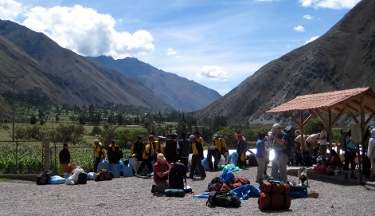
A bit crowded gearing up to begin, but the crowds thin out once you start hiking
Let me preface this by saying that you have many, many options when it comes to hiking to Machu Picchu. The classic Inca Trail is most popular, most crowded, and most expensive. So why take this trail you may be wondering? Because it’s the only one that has hikers at the Sun Gate for sunrise over Machu Picchu, and for me, that trumped everything. That’s what I wanted to see, and even though I knew that bad weather could completely ruin this for me by totally obstructing the view of Machu Picchu from the Sun Gate, I was willing to take the risk (and thank God we did because we had a beautiful morning upon arrival).
Despite being more crowded (they still limit the trail to 200 trekkers per day) and expensive than other trails, we were quite happy with our decision. It passed by many other Incan ruins, and it was a bit shorter and easier than alternative treks. Despite hearing some complaints from hardcore trekkers about the crowds, we didn’t find there to be too many people at any one time. Everyone goes at their own pace and the crowds stretch out along the way. Being that we aren’t expert hikers, this route just seemed like the right one for us. Keep in mind that if you do decide to hike the Inca Trail, it will have to be booked in advance, sometimes many months in advance. The advantage of hiking one of the alternative trails is that you can just turn up in Cusco and book it. You’d have to be really lucky for this to happen with the classic Inca Trail.
What Company to go With
We read a great deal about different companies when researching the Inca Trail. There are many to go with, but the one that we kept seeing over and over and over when it came to positivity was Peru Treks. I honestly don’t recall seeing a bad review written about them, and after going on the trek, I can see why. They were top notch and professional in every single aspect of the trek, and I can’t recommend them enough. That’s not to say that other’s aren’t good, too, but based on our experience, you can’t go wrong with Peru Treks.

The views get better and better the further you go-this was from the very beginning
The views get better and better the further you go-this was from the very beginning
Cost
$465US/person
Holy shit, seriously? WHAAAAA?!?!?! I know, I know, for all you budget-minded backpackers out there reading this, that’s some serious sticker shock, right? We were in your shoes as well, so we totally understand. Nearly a grand for a 4 day hike for 2 people puts some serious kinks in the old budget, but this is why you’re reading this site and planning. It does include a lot, so keep reading.
If you plan ahead, it’s so, so, so worth the money. I can’t stress it enough. I am a cheap ass when it comes to stuff like this, but the extra money you’ll spend to go with a refutable company like Peru Treks will be money well spent. They treat their porters well, they give unheard of customer service, their guides are the best and are very well educated on the surrounding, and then there’s the food.
But the food, seriously, the food- Nearly two years after we did this hike, my mouth still waters and my brain is still confused when thinking about the food we ate on this trek. What these chefs were able to do with the food they had (which was ALL carried in by our rock star porters) and the equipment they used to cook with is nothing short of amazing. These guys would make the cooks on Top Chef look like little bitches, and having top notch cuisine on a four day hike in the Andes is something that should not be overlooked.
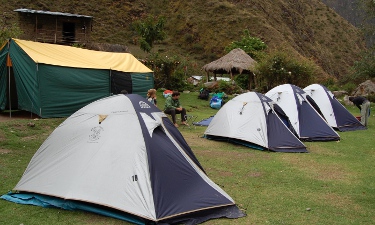
Every day we arrived to an already set-up camp by our awesome porters
The nitty-gritty-What the price includes- So while the cost is high, it does include pretty much everything:
- Tent and sleeping pad for all three nights (you can rent a sleeping bag for a bit extra)
- All meals and water, from lunch on day one to breakfast on day four, which as mentioned before (and which will be mentioned again and again) was unbelievable
- Entrance fee to Inca Trail and Machu Picchu ($85US/person)-see, now we’re getting somewhere with that high price
- Bus from Cusco to Ollantaytambo and the start of the trek
- Bus from Machu Picchu to Aguas Calientes after the hike ($7US/person)
- Train from Aguas Calientes to Ollantaytambo ($31US/person); side note-this train ride was hilarious, so make sure you read the Inca Trail recap post
- Bus from Ollantaytambo back to Cusco ($5US/person)
- Porters-these guys carry all the tents (including the one you’ll be sleeping in and eating in), food, cooking equipment, and other various things so you don’t have to think about it
- All sales tax
What isn’t included
- Sleeping bag (you can rent these from Peru Treks for a cheap fee)
- Breakfast on the first day in Ollantaytambo and lunch in Aguas Calientes on the final day
- Personal porter to carry up to 13 pounds (6kg) more of your stuff (cost is $40/total for all four days)
- Tips-these guys deserve good tips, and you’ll be happy to pay it when it’s all said and done. They really do make it as easy as possible for you and do everything short of giving you a piggyback ride along the entire trail

The ruins of Sayaqmarca along the Inca Trail
The ruins of Sayaqmarca along the Inca Trail
How to Prepare
If you haven’t read my Trekking Guide for Beginners and those who Like to Eat and Drink a lot, then you should start there. But for more in depth information geared specifically for hiking the Inca Trail to Machu Picchu, then read on:
- Don’t worry, be confident, you’ll be fine- Like any hike that is written about on this site, virtually anyone in decent physical condition should be able to finish. The Inca Trail is no different. It’s a smart idea to do some training and get in as good of shape as possible obviously, but if you aren’t a marathon runner, you’ll be fine. It is a very challenging and difficult hike, but on the trail, we saw, among others:
- several people in their 60′s, none of which were “freakish people in their 60′s who really like they’re 30.” While a few were struggling mightily during parts of it, they finished and were all smiles on day four traipsing around Machu Picchu
- a woman who was 6 months pregnant. You can argue about the stupidity of this among yourselves, but I just wanted to point out that she made it just fine
- a woman in our own group who had never hiked or camped before-yep, that’s right
- Rest and acclimate- Pretty self-explanatory-get to Cusco several days before your hike and rest and acclimate, don’t drink and party. You know I like to drink and party with the best of them, but take my advice and wait until you’re finished, then drink yourself stupid. If you have the time, get to Cusco as far in advance as possible so you can not only rest but maybe do a few day hikes around the area to get used to hiking at this altitude. You don’t want altitude sickness in the middle of the Andes Mountains; it’s not fun as we found out on our Colca Canyon trek.
- Bring appropriate clothing- No matter what time of year, it can rain in the mountains. Some times are rainier than others (like the rainy season, duh), but even in dry season you can get rained on. On the same note, it can get really cold, especially at night. So bring lightweight, moisture wicking clothing that you can layer. You will probably be adding and shedding clothing all day long during your hike, so just be aware and come prepared. A poncho or rain jacket is advisable, as is waterproof footwear. Non-waterproof footwear=wet feet=blisters=sucky time on the trail
-
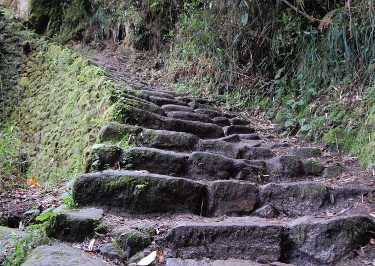
You will want walking sticks when going down the "Gringo Killer"
Be smart in how you pack- Packing for a multi-day trek, especially if you’ve never done so before, can be frustrating and confusing. So much depends on your pack. Is it top loading or front loading? How many, if any, outer pockets are there? Here are a few tips for packing your bag. If you have someone else with you to share the load, even better.
- Know exactly where everything is in your pack-being organized is very, very helpful while on the trail. You don’t want to have to rip your pack off and unpack the entire thing to find your rain jacket when the skies open up.
- If you plan on taking a lot of pictures, have your camera easily accessible in your pack or just have it on your person so you can quickly whip it out.
- Have snacks easily available-if you have an outer pocket that you or your hiking partner can easily get to, this is a good place to keep them. Having to take your pack off and rummage through it find a cookie is annoying.
- Keep your things you know you won’t need on the trail (like your sleeping bag and mat) in the bottom or in a place that won’t get in the way.
- In short, just use common sense when packing. If you know you may need it when on the trail, then put it near an exit point of your pack so you or your partner can easily grab it.
- Bring walking sticks- You can rent these from many different places in Cusco. Do it. Walking sticks are a life saver, especially on day three when going down the Gringo Killer. They save so much stress on your knees, so just get them and thank me later.
- Learn a little about the Incas beforehand- Check out the Museo Inka in Cusco before coming. Another option is to explore the ruins in and around Cusco. Read a few books or at the very least your guidebook about the history of the Incas, the Inca Trail, and Machu Picchu. If you decide to go with a company like Peru Treks, your guide will be very well educated on all this stuff, and you will learn tons during the trek itself, but it always helps to have a little background information before you go. Then you can throw out little facts you learned and everyone will think you’re smart, so win-win, right?
- Go at your own pace-I can’t stress this enough. The best way to get yourself into trouble while on a long hike is to hike above your means. If you’re hiking with someone else and they are faster, just be honest with yourself and accept it. Don’t try to be a hero and don’t try to make it a race. Go at your own pace, stop and rest when you need to, drink plenty of water and eat plenty of food, and just enjoy yourself. You’re doing this for fun, remember? Running the trail and trying to keep up with the porters will not be fun.
- Read the Inca Trail recap- Finally, read this two part recap of our four days on the Inca Trail and our day spent at Machu Picchu. It truly was a highlight not only of our year long trip, but also of my 32 year life. It’s that awesome. So if you’ve ever thought about seeing these famous ruins, what are you waiting for? Get out there and do it!

Everything you plan and go through will be worth it to see this...